Constructive feedback
You feel present, breathing remains easy, and the movement is controlled.
Guide / Attention / 2026
A quiet introduction to balance practice, exhalation, and the value of a stable setup.
Control often begins by reducing the rush to begin.
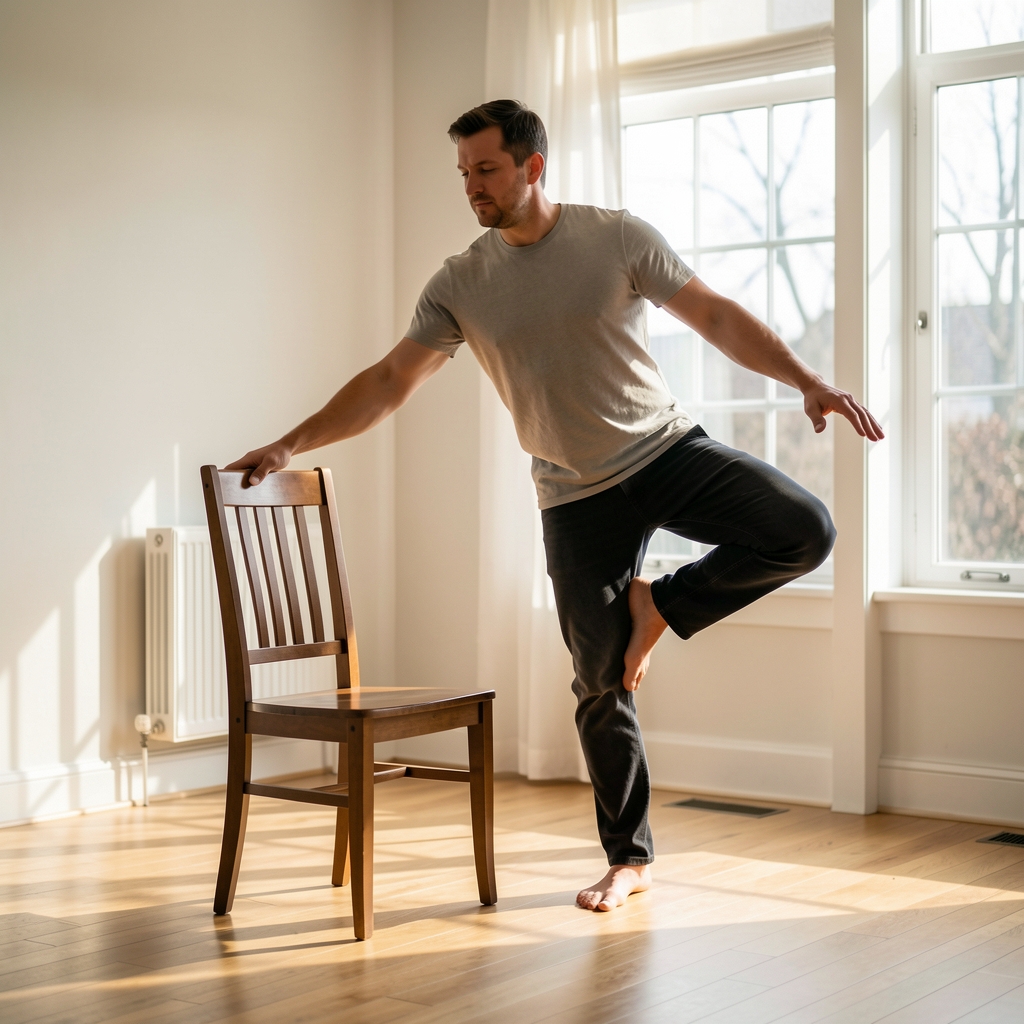
Choose a clear floor, a stable surface, and a moment when you do not need to hurry. Stand near a wall or chair. Let your eyes rest on one point and breathe naturally before shifting weight.
Use the smallest movement that lets you stay attentive. If steadiness changes, return both feet to the floor and pause. The aim of this guide is observation and preparation, not a performance target.
Short practice is easier to review when the setting remains familiar. A chair, wall, or counter can provide a clear boundary without turning the sequence into a test.
| Cue | Notice | Useful adjustment |
|---|---|---|
| Feet | Pressure and contact with the floor | Reduce the range and widen the stance. |
| Breath | Whether breathing becomes rushed | Pause and return to an easy rhythm. |
| Eyes | Whether the room feels visually busy | Choose one calm reference point. |
| Support | Distance from a stable surface | Move closer before continuing. |
You feel present, breathing remains easy, and the movement is controlled.
You feel unsteady, unusually tired, or unable to maintain a safe setup.
The same part of the sequence repeatedly feels unclear or difficult to describe.
Use the order to keep attention on the environment before the movement.
Stand or sit comfortably and notice the room, surface, and available support.
Allow several natural breaths without trying to lengthen or control them.
Transfer a small amount of weight while keeping a clear route back to both feet.
Finish with a stable stance and a short walk before returning to the day.
If the setting no longer feels stable, return to a supported position, pause, and consider discussing the experience with an appropriately qualified local professional.
This guide is general information and does not assess an individual reader.
Derive, 120 Cihampelas Street, Bandung, West Java 40131, Indonesia. Phone +62 22 731 8975. Reviewed 14 October 2026.
Balance is influenced by more than the movement itself. A glossy floor, uneven threshold, strong glare, a noisy room, or a chair that slides can change the amount of attention required. Before beginning, scan the space and choose the simplest arrangement available. The same sequence may feel different in a bedroom, a hallway, or an outdoor path.
Breath can be used as an observation cue without forcing its length or depth. Notice whether the rhythm becomes rushed when the feet shift, then reduce the movement or return to a stable position. A pause is a useful piece of information, not a failure. If a sensation remains concerning or difficult to interpret, discuss it with an appropriately qualified local professional.
Keep a brief record if it helps: date, setting, support, movement size, and what changed when you paused. Avoid recording another person's information or sending a private log through a public form. Derive guides are general editorial material and do not replace an individual conversation.